The Intelligence Trap
Why Solving Intelligence Won't Automatically Solve the Global Health Workforce Crisis
Can machine intelligence resolve the global shortage of health workers? While algorithms are transforming clinical information processing and offering visions of plentiful health services, the grounded realities of clinical delivery tell a different story. In this deep dive, we explore the multifaceted nature of healthcare work, clinical workflow bottlenecks, health worker competencies for an AI era to make a case why automating cognitive tasks alone will not reduce, and will possibly increase the demand for health workers, albeit with reconceptualised competencies, in our health systems.
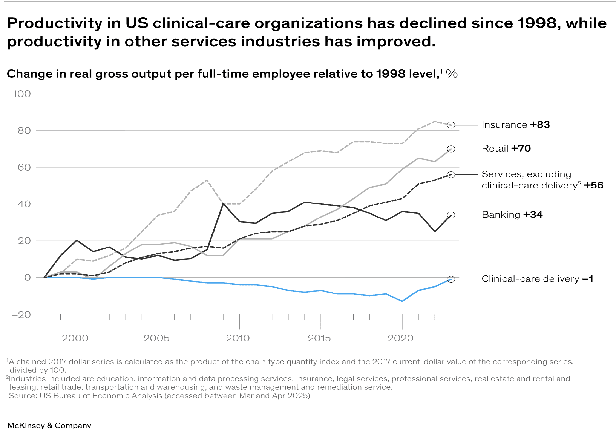
In July this year, the consulting company McKinsey put out a report on the future of work in healthcare that began with a startling datapoint: In the past two decades, while labor productivity in the overall US service economy had gone up more than 55%, in clinical care delivery, labor productivity had gone down by one percent over the same period. These figures are from the US, but figures for the developing world are likely to be no better, and possibly even worse, given these economies tend to be less dynamic.
Although the health workforce is the primary input component into a health system, poor productivity is hardly the only problem that besets this critical input—there just aren’t enough health workers to begin with. By 2030, the world is expected to have a shortfall of about 11 million health workers. The developing world bears the greater brunt of this health worker deficit, partly because they have less health workers (and less money to spend on them), but also because their health systems have to compete with the developed world for the same labour pool owing to outmigration. Then there is the issue of an ageing population and health workforce: over the next several decades, many countries deemed to have stable health systems could require 830,000 additional health workers just to maintain current staffing ratios. Our global priority in providing universal access to essential health services is struggling, largely and precisely because the world over, we do not have enough health workers. All in all, the world needs more health workers.
So while there is a global discussion around AI led job displacement in several industries, in healthcare, displacement is not the main story. Or at least that should not be the main story. The main story, and a hopeful possibility, is that AI fills the healthcare jobs that we can’t seem to fill. In several other industries, in pursuing economic efficiency and expediency, AI may have to vie for the job people are already doing, and rob them off their livelihoods. In healthcare, AI could just take the jobs we don’t have health workers for. When implemented right, no domain of human endeavor would have reasons to be hopeful about — or more reasons to celebrate — an AI-led transformation of the workforce than healthcare.

Figure 1. Productivity change in terms of real gross output in the US economy per full-time employee (compared to a baseline of 1998). Source: McKinsey & Company. Copyright owned by McKinsey & Company.
In anticipation of the incipient advances in health artificial intelligence, conversations have been abuzz about a possible AI-led transformation of the health workforce since at least a decade now. Back then, predictions that clever AI algorithms would soon take over most of what doctors traditionally do and make health services plentiful had already begun to surface. However, a decade later, even though AI seems to have notably advanced, its impact on the workforce, or service delivery, isn't materially different from what it was then.
Technologically, AI's progress is undeniable. In domains like generative AI, the progress could even be considered dramatic. In many information processing and analytic tasks, generative AI models beating humans, physicians included, has become almost comically humdrum. A decade ago, artificial intelligence was beginning to make sense of chest x-rays and histological slides. Today, AI models are so advanced they score better than physicians in licensing examinations, and what’s baffling is that such AI feats are considered quotidian no sooner than they appear. As John McCarthy — who gave birth to the phrase artificial intelligence — once quipped: as soon as it works, no one calls it AI anymore!
Such amnestic attitudes miss the long arc of progress in artificial intelligence. To arrive at a point where we are hardly even contesting the claim that an AI model can match or surpass human physicians at answering clinical vignettes is a clear sign of progress for artificial intelligence, and presumably even more so for society. Just a while ago, our definition of an intelligent system — the oft-quoted Turing Test — was a conversational chatbot capable of answering indistinguishably from a human. Here, it is scoring off the charts in tests smart medical students and physicians toil months preparing for. At this point, the AI models are blowing the Turing test off the water. And if people just scoff it off, that is missing the point.
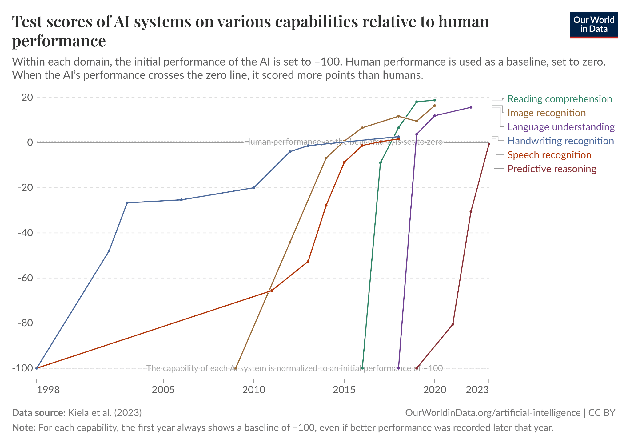
AI has clearly arrived at a point where, in several information processing tasks, including those in healthcare, it is demonstrably performing better than the average human (Figure 2). Granted, these claims are heavily anchored by the operative phrases “doing better”, or the “average human”, which are often operationalised through subjectively determined benchmarks, and are thus wont to normative interpretation. So there are caveats aplenty. Nevertheless, AI may indeed have already begun to make intelligence, narrowly defined, readily available.
From a societal perspective, nowhere is this promise of plentiful intelligence as tantalizing as it is in improving access to health services, especially in the developing world. Despite breakneck economic and productivity growth in several sectors of the economy over the past several decades, in healthcare and other such service industries, we have seen very little if any productivity increase, a phenomenon famously elucidated by William Baumol in his model of the cost disease of services and unbalanced economic growth. So with rising economic growth, even while more people are able to afford material goods like TV and cars, less and less people appear to be able to afford healthcare on their own. AI’s promise is tantalizing precisely because it could put a break on this productivity deficit in a service industry like healthcare and make health services more affordable.

Figure 2. Test scores of AI systems categorised by capabilities compared to human performance. Source: Our World In Data. CC BY. Underlying data copyright remains with the respective rights holders.
And yet, we are far from any meaningful progress in using these advances to improve health services delivery, let alone making health services plentiful, or improving health outcomes for people. AI models may well solve clinical vignettes in licensing examinations, but turns out there is a broad chasm between solving clinical vignettes and helping heal a patient who is writhing in pain, maybe even cranky, and potentially fighting a life threatening illness. And even more so doing it affordably, and at scale. That is not to mean the promise does not hold, but as we are beginning to discover, the issue is more complicated than clever algorithms that ‘solve intelligence’ will be able to handle on their own.
Thus far, conversations on the possible impact of AI on the health workforce miss the depth of thought it requires. The AI-will-make-doctors-obsolete point of view appears driven more by a technological chutzpah, than a careful consideration of the complex nature of the issue. A cursory examination of where radiology—a profession several people said would soon be rendered obsolete at the hands of AI—is today, proves this point. Although, over the past decade, AI-maximalists have written enough obituaries on radiology as a profession, both radiologist job vacancies, and pay have grown over this period.
This is because the AI-will-make-doctors-obsolete trope largely mischaracterises healthcare work and the layered role that doctors and other health workers play within the health system. A 2013 study in Canada showed that only about 36% of a radiologist’s time is spent interpreting images, with the rest of the time spent in teaching, consulting and coordinating with other care providers, and fulfilling various other subroles that the job demands. This 36% part that AI models are able to emulate, and is sometimes tested through clinical vignettes, is a subset—albeit an important one—of a physician’s role. If that particular function, i.e. information processing, interpreting images, or decision making is done better by the models, that does not mean the part of the workflow that comes before the information processing and analysis, and the one that follows will also be automated efficiently. As any person who has done a clinical job will profess, the 64% of the time spent not reading images directly contributes to the quality, and maybe even the quantity of image interpretation, and will arguably be even more valuable when the algorithms automate and commoditize image interpretation.
When image interpreting is automated, getting the information in the form that the models can parse and process will prove to be valuable. And so will exercising judgment over the decisions the AI models make, and acting upon the decisions the models make. Figure 3 graphically represents a typical healthcare workflow, as a 5 step process, drawn in part from information processing theory. What AI allows us to do is automate much of Step 3 in this process. That still means the other parts of the process need to be taken care of. In fact, step 3 being sped up not only may create a bottleneck elsewhere in the workflow, but also create newfound demand for the other tasks and functions that come before and after this step, thereby rendering them critical and valuable.
In such a scenario, it is highly likely that future doctors and health workers will have to focus on fulfilling upstream and downstream tasks and functions that cannot be fulfilled by the algorithms. And in the process the role of the physician and health workers itself will change.
| Gather Information | ➔ | Store & Retrieve Information | ➔ | Process & Analyse Information | ➔ | Make Decisions | ➔ | Act on Decisions |
|---|---|---|---|---|---|---|---|---|
| STEP 1 | STEP 2 | STEP 3 | STEP 4 | STEP 5 |
Figure 3: A broadview archetype of a clinical workflow in healthcare settings, informed by information processing theory.
Not all of healthcare can be reduced to information that can be captured in computer analyzable bits and bytes. AI models as they currently stand, operate in the unidimensional world that can be rendered on paper, or on a computer storage device. Healthcare operates in the multidimensional spatial locus that cannot be neatly rendered on a computer file waiting to be interpreted by an automaton: the conversations that are often left unspoken, the emotions that are merely signaled, the values that are coded into culture. Health issues are macabre and mental, solid and amorphous, sometime all at the same time. The organs may be objectively well, but the patient could still be unwell. The AI models are likely to have a hard time catching that. For that, we will still need a health workforce that can make sense of the information, but also the emotions, the values, and the cultural subtexts that drive our decisions and choices in healthcare.
Efforts to transform the health workforce and healthcare through AI will have to be cognizant of these shifting sands. For eons until the AI revolution arrived, owing to increasing complexity and the voluminous nature of medical information, medical practice and hierarchies were increasingly built around gaining specialised knowledge about a sliver of the human body, and devoting oneself to perfecting that art and science. Being able to generalize and draw upon multiple bodies of knowledge and understanding was not necessarily valued. Now, when AI is exceeding humans in the information processing and analysis, such a reductionist approach to medicine seems increasingly suited to algorithms. As highlighted by a recent perspective piece in the New England Journal of Medicine, generalist knowledge that extends beyond the defined limits of an organ system or a system of practice appear increasingly relevant, and heck, even essential to the successful practice of medicine.
Before we can solve healthcare with AI, we need to figure out how best to prepare a health workforce with a skillset complementary to the capabilities offered by AI. That transformation will start with a recognition and an admission of the fact that, in era of plentiful information processing capability, healthcare work will be quite different from it was before the AI revolution.
The Future Physician’s Competency Triad
Redesigning the health workforce for the AI era will require thinking about, and planning for, how best to prepare and capacitate the health workforce to complement the cheap information processing that AI models will do. Our health workforce of the future will have to be trained to address this new reality. How best to prepare future physicians for the future is a subject of ongoing debate. Here, we propose competencies that encapsulate proficiencies expected of future doctors and health workers into a framework, what could be termed as the Future Physician’s Competency Triad.
-
Epistemic Interpretation: Interpret machine made decisions on the patient’s behalf
When machines are processing information and making decisions at close to no-cost, the critical clinical function will be exercising judgement over these decisions. For example, current AI integrated radiology workflows are generating significant false positives that require the radiologist, or the treating physician, to marry with the rest of the available clinical information and the context to make sense of. Epistemically interpreting what the AI output means for the given clinical context will be one of the most important functions for health workers in the future.
-
Values Alignment: Help align those decisions to the patient or society’s value system
AI made medical decisions are likely to be values-agnostic. However, healthcare is not values agnostic. Individual, social and societal values and cultural guideposts deeply and heavily influence not only the concepts of sickness and health, but also our response to sickness and care seeking patterns. And as values and cultures differ between people and societies, making sense of these decisions for a particular patient or a community will likely require a human health worker to contextualise. In the age of AI it will be especially important for health workers to arbitrate these value judgements over machine made medical decisions on behalf of their patients.
-
Fiduciary Responsibility: Bear fiduciary and statutory responsibility for the care that is provided
A final third of the triad relates to who will be responsible for the care that is provided for patients. Whether humans or machines that are making the decisions, there needs to be responsibility for the outcome of the care that is provided. The buck has to stop somewhere, or else patients will have no trust left in the health systems and they may fear seeking care. And chances are, given a choice, patients will still want their health workers (physicians especially) to be responsible for that care.
As long as patients prefer their physicians to be responsible for the care that is provided to them, as long as they act as a values arbiter in negotiating their clinical care, and as long as physicians are able to epistemically interpret the deluge of information processing output that is bound to be generated at the hands of AI, physicians and health workers will be highly sought after within the health system. They just need to find out complementarity in their work functions with the AI models.
But before we can truly begin to impact healthcare—and solve healthcare—with AI, it's not just the health workforce that will have to change. The health systems and the institutional context in which health systems exist will also have to change—adapting to accommodate AI integrated workflows. The regulatory environment will require rethinking so it can constructively regulate AI-integrated workflows. Such forward looking regulatory approaches are underway. At the same, we need to be hard nosed about the economics of AI-integrated health systems. If the token economics are such that integrating an AI agent is fairly comparable to hiring a human health worker, an AI led transformation of healthcare will be a mere pipedream. Already such scenarios are beginning to play out. And not to mention, we need to figure out a way to engage with patients and the community and engender their trust in AI-integrated workflows and AI made decisions. Without engendering patient trust, healthcare will not budge, let alone be transformed.
Until the day that it is humans—and not machines—that are suffering from diseases, it is hard to imagine that health workers are being rendered obsolete. Their roles will change, they may not be the ones doing the most analytic heavy lifting, but they will be the ones ultimately responsible for the care.
And if Jevons’ paradox—the idea that demand for an input may go up as its efficiency goes up—is anything to go by, AI could dramatically increase the information processing function in healthcare, and therefore paradoxically increase the demand for doctors and health workers who fulfill functions that are upstream and downstream to information processing, or functions that the AI has no way of fulfilling. Precisely for this reason, it is likely that the AI revolution will increase, not decrease, the demand for health workers. Albeit ones with a role that is fundamentally transformed.