Research

Pushing the frontiers of AI for equitable innovation through autonomous research groups.

Research Circle

Research Areas

Knowledge Representation & Reasoning
Computer Vision
Natural Language Processing
Federated & Privacy- Preserving Learning
Multimodal AI
Speech & Audio Processing
Learning Algorithms & Optimization
Research DecorationsScientific Progress

Expand human knowledge through high-integrity research that pushes the frontiers of AI.

Research DecorationsSectoral Impact

Address critical real-world challenges where AI can create valuable impact.

Research DecorationsGlobal Equity

Ensure benefits of AI reach everyone and its progress is shaped by all.

Our Impact

0+

publications in top-tier venues

$0.0M+

research funding accross 9 international grants

0%

international collaboration rate

0

open-source repositories impacting the AI community

Featured Projects

Feature Publications

2023
FUTURE-AI: International consensus guideline for trustworthy and deployable artificial intelligence in healthcare
Karim Lekadir, Bishesh Khanal, Martijn Starmans
arXiv preprint arXiv:2309.12325 , 2023
PDFView PDF
2025
Transforming healthcare through just, equitable and quality driven artificial intelligence solutions in South Asia
Sushmita Adhikari, Iftikhar Ahmed, Deepak Bajracharya, Bishesh Khanal, Chandrasegarar Solomon, Kapila Jayaratne, Khondaker Abdullah Al Mamum, Muhammad Shamim Hayder Talukder, Sunila Shakya, Suresh Manandhar, Zahid Ali Memon, Moinul Haque Chowdhury, Ihtesham ul Islam, Noor Sabah Rakhshani & M. Imran Khan
npj Digital Medicine (nature)
Peer Reviewed Journal articleTOGAI (Transforming Global Health with AI)
PDFView PDF
2025
Assistive Artificial Intelligence in Epilepsy and Its Impact on Epilepsy Care in Low- and Middle-Income Countries
Nabin Koirala, Shishir Raj Adhikari, Mukesh Adhikari, Taruna Yadav, Abdul Rauf Anwar, Dumitru Ciolac, Bibhusan Shrestha, Ishan Adhikari, Bishesh Khanal, Muthuraman Muthuraman
Brain Sciences (MDPI) 2025
Peer Reviewed Journal articleTOGAI (Transforming Global Health with AI)
PDFView PDF
2025
Multimodal Federated Learning With Missing Modalities through Feature Imputation Network
Pranav Poudel, Aavash Chhetri, Prashnna Gyawali, Georgios Leontidis, Binod Bhattarai
Medical Image Understanding and Analysis (MIUA) 2025
Peer Reviewed Conference articleBBMMLL (B Bhattarai Multi-Modal Learning Lab)
PDFView PDF
2024
NLPineers@ NLU of Devanagari Script Languages 2025: Hate speech detection using ensembling of BERT-based models
Anmol Guragain, Nadika Poudel, Rajesh Piryani, Bishesh Khanal
CHiPSAL: Challenges in Processing South Asian Languages. COLING 2025
Peer Reviewed Workshop articleTOGAI (Transforming Global Health with AI)
PDFView PDFSource Code

News & Updates

Coding the Parallel Bayesian Update : Part 5
June 30, 2026
Coding the Parallel Bayesian Update : Part 5
By: Krischal Khanal Example Suppose you draw a ball from one of three urns, and you are not told which urn it came from: Urn Prior $P(H_i)$ $P(\text{red} \mid H_i)$ A 0.2 0.9 B 0.5 0.4 C 0.3 0.1 You draw a red ball. What is the probability each urn was the source? By: Krischal Khanal Coding the Parallel Bayesian update def bayesian_update_multi(priors, likelihoods): """ priors : list of P(H_i) — must sum to 1 likelihoods : list of P(E | H_i) — one per hypothesis Returns : list of posteriors P(H_i | E) """ # Compute unnormalized posteriors unnormalized = [p * l for p, l in zip(priors, likelihoods)] # Marginal P(E) is the normalizing constant marginal = sum(unnormalized) # Normalize posteriors = [u / marginal for u in unnormalized] return posteriors # Urn example priors = [0.2, 0.5, 0.3] likelihoods = [0.9, 0.4, 0.1] posteriors = bayesian_update_multi(priors, likelihoods) labels = ["Urn A", "Urn B", "Urn C"] for label, prior, posterior in zip(labels, priors, posteriors): print(f"{label}: prior={prior:.2f} → posterior={posterior:.3f}") Urn A: prior=0.20 → posterior=0.439 Urn B: prior=0.50 → posterior=0.488 Urn C: prior=0.30 → posterior=0.073 The red ball makes urn B slightly more likely than urn A, and strongly disfavors urn C. Sequential updating with multiple hypothesis The same composability from the last blog applies here. Each posterior becomes the next prior. def simulate_sequential_updates(priors, evidence_sequence, likelihood_table): """ priors : initial list of P(H_i) evidence_sequence : list of evidence labels (e.g., ['red', 'red', 'blue']) likelihood_table : dict mapping evidence label → list of P(E | H_i) """ current = priors[:] for evidence in evidence_sequence: likelihoods = likelihood_table[evidence] current = bayesian_update_multi(current, likelihoods) print(f"After observing '{evidence}': {[f'{p:.3f}' for p in current]}") return current likelihood_table = { "red": [0.9, 0.4, 0.1], "blue": [0.1, 0.6, 0.9], } print(f"Initial priors: {priors}") final = simulate_sequential_updates([0.2, 0.5, 0.3], ["red", "red", "blue"], likelihood_table) Initial priors: [0.2, 0.5, 0.3] After observing 'red': ['0.439', '0.488', '0.073'] After observing 'red': ['0.681', '0.305', '0.015'] After observing 'blue': ['0.120', '0.323', '0.557'] Two red balls shifted belief strongly toward urn A. One blue ball then swung it back toward urn C. The hypotheses compete on every draw. In this blog, we got a little peek into what happens if evidences are different, namely observing two "red" and one "blue". In the next blog, we will dive deeply into evidences that are stochastically observed, and how the belief are shaped by them. Stay tuned. Code blocks are licensed under the MIT License. All other content is licensed under CC-BY 4.0 Copyright © 2026 Krischal Khanal.
Decoration
Missing Half in the Baye's Theorem : Part 4
June 22, 2026
Missing Half in the Baye's Theorem : Part 4
By: Krischal Khanal In the previous blogs, we saw how to use Bayes' Theorem to update belief. Then we coded that up, and ended with a question on what if result is stochastic? However, to understand that we must understand one missing piece of the Bayes' Theorem. Bayes' Theorem is classically defined as: [!Identities] $$P(H | E) = \frac{P(H) \cdot P(E | H)}{P(E)}$$ Where, $$P(E) = P(H) \cdot P(E | H) + P(\neg H)P(E | \neg H)$$ Where, the symbols are defined as: $H$ : Hypothesis $E$ : Evidence/event Using Bayes' Theorem we are able to update the belief of hypothesis in the light of evidence. In other words, $P(H)$ updates to $P(H|E)$. [!note] The belief in a hypothesis means "how much certain are you that the hypothesis is true?" Thus, if hypothesis is $H$, belief in that hypothesis is $P(H)$. It's a probability. If you assign a probability to your belief, you also implicitly assign rest of the probability for the exact negation of the belief. Let's take the same example of rare disease. If $H$: You have the rare disease. $P(H)$ is your belief in you having that disease. Then, $\neg H$: You do not have the rare disease. $P(\neg H)$ is your belief in you not having that disease. It's always the case that, $$P(\neg H) = 1 - P(H)$$ If you can use Bayes' Theorem to update $P(H)$, you can also update the $P(\neg H)$ using the same theorem. Thus, [!Identity] Complementary Bayes Theorem $$P(\neg H | E) = \frac{P(\neg H) \cdot P(E | \neg H)}{P(E)}$$ This is the missing half of the Bayes' Theorem. It might seem obvious, in part because it's obvious. But generalizing this, we gain a profound understanding of the Bayes' theorem. Generalizing the Bayes' Theorem: 1. Multiple hypotheses Here we consider two competing, mutually exclusive hypotheses: $H$ and $\neg H$ If we sum all the mutually exclusive hypothesis. $$P(H | E) = \frac{P(H) \cdot P(E | H)}{P(H) \cdot P(E | H) + P(\neg H)P(E | \neg H)} \tag{a}$$ $$P(\neg H | E) = \frac{P(\neg H) \cdot P(E | \neg H)}{P(H) \cdot P(E | H) + P(\neg H)P(E | \neg H)} \tag{b}$$ Adding them, $$P(H | E) + P(\neg H | E) = 1$$ And, if there were $n$ mutually exclusive hypotheses: $H_1, H_2, \ldots H_n$ Using Bayes' Theorem for each one, we get: $$P(H_i | E) = \frac{P(H_i) \cdot P(E | H_i)}{P(H_1) \cdot P(E | H_1)+ P(H_2) \cdot P(E | H_2)+ \ldots + P(H_n)P(E | H_n)}$$ Equivalently, $$P(H_i | E) = \frac{P(H_i) \cdot P(E | H_i)}{\sum_{k=1}^n P(H_k)P(E | H_k)}$$ [!note]+ Every denominator can be replaced by $P(E)$, but it's important to emphasize that it's composed of multiple hypothesis, and your belief has a role in shaping the overall marginal probability $P(E)$. Using Bayes' Theorem in Parallel: $$\begin{bmatrix} P(H_1 | E) \ P(H_2 | E) \ \vdots \ P(H_n | E) \end{bmatrix} \frac{1}{\sum_{k=1}^n P(H_k)P(E | H_k)} \begin{bmatrix} P(H_1) \cdot P(E | H_1) \ P(H_2) \cdot P(E | H_2) \ \vdots \ P(H_n) \cdot P(E | H_n) \end{bmatrix} $$ Keep in mind, the sums of mutually exclusive hypotheses remain 1 even after update. $\sum_i P(H_i)=1$ $\sum_i P(H_i | E) = 1$ Bayes' Theorem is only shifting the probabilities (adjusting the belief) among the hypotheses based on the evidence. [!bonus]- What if hypotheses aren't mutually exclusive? We can update the belief just the same, but the sum of the probabilities isn't guaranteed to be a constant. Thus, we are able to update belief of discrete probability distribution over the finite hypothesis. Generalizing the Bayes' Theorem: 2. Continuous domain We can even generalize where domain of hypothesis is continuous, and belief is in the form of probability density function. $$P(\theta | E) = \frac{P(\theta) \cdot P(E | \theta)}{\displaystyle\int P(\theta')P(E | \theta') d\theta'}$$ This is the foundation for Bayesian Inference. If you imagine E being data and $\theta$ being parameters of probability distribution model i.e. your belief, then $P(\theta | E)$ is your updated belief after you've seen the data. This is an example of Bayesian inference in action. In the next blog we'll look into coding the parallel bayesian update for multiple hypothesis. Code blocks are licensed under the MIT License. All other content is licensed under CC-BY 4.0 Copyright © 2026 Krischal Khanal.
Decoration
Coding the Bayesian Update : Part 3
June 18, 2026
Coding the Bayesian Update : Part 3
By: Krischal Khanal Coding the Bayesian update def bayesian_update(prior, likelihood_given_true, likelihood_given_false): """ prior : P(H) — prior probability of hypothesis likelihood_given_true : P(E|H) — probability of evidence if H is true likelihood_given_false: P(E|¬H) — probability of evidence if H is false """ marginal = (prior * likelihood_given_true) + ((1 - prior) * likelihood_given_false) posterior = (prior * likelihood_given_true) / marginal return posterior # The rare disease example prior = 0.001 # 1 in 1000 people have the disease p_e_given_h = 0.99 # test sensitivity p_e_given_not_h = 0.05 # false positive rate posterior = bayesian_update(prior, p_e_given_h, p_e_given_not_h) print(f"Posterior probability of disease given positive test: {posterior:.4f}") # Output: Posterior probability of disease given positive test: 0.0194 Sequential updating One elegant property of Bayesian updating is you can do it repeatedly. The posterior from one update becomes the prior for the next. Let's say you took a second, independent test, and it also comes back positive: # First positive test posterior_1 = bayesian_update(0.001, 0.99, 0.05) print(f"After first positive test: {posterior_1:.4f}") # Second positive test — use posterior_1 as new prior posterior_2 = bayesian_update(posterior_1, 0.99, 0.05) print(f"After second positive test: {posterior_2:.4f}") After first positive test: 0.0194 After second positive test: 0.2818 After two independent tests, which came out positive both times, you now become 28% sure you have the disease. The evidences accumulate to form a more informed hypothesis. Imagine you took a third test, and it came out positive too. # Third positive test — use posterior_2 as new prior posterior_3 = bayesian_update(posterior_2, 0.99, 0.05) print(f"After third positive test: {posterior_3:.4f}") After third positive test: 0.8860 After third test that came out positive, you are now 88.6% certain that you have the disease. But what if test result isn't always positive, but sometimes positive and sometimes negative, i.e. stochastic? We'll answer it on the upcoming blog in the blog series. But in order to understand it, we must understand the missing half of the Bayes' Theorem. Code blocks are licensed under the MIT License. All other content is licensed under CC-BY 4.0 Copyright © 2026 Krischal Khanal.
Decoration
How to apply Baye's Theorem to update belief : Part 2
June 17, 2026
How to apply Baye's Theorem to update belief : Part 2
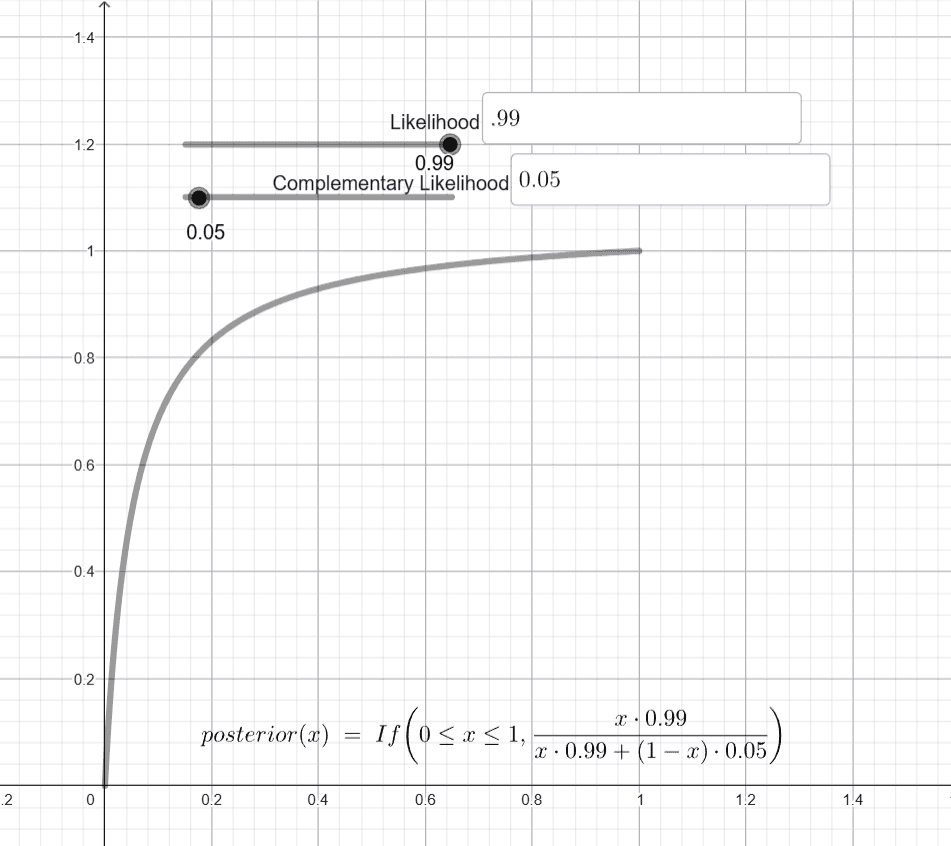
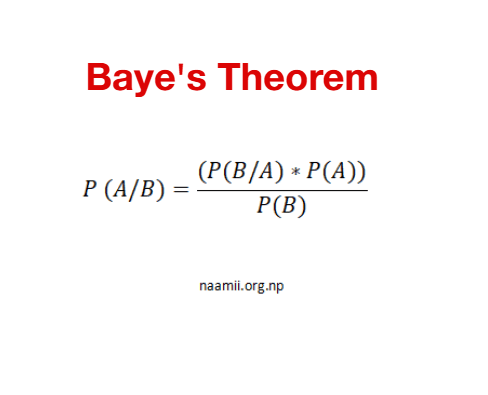
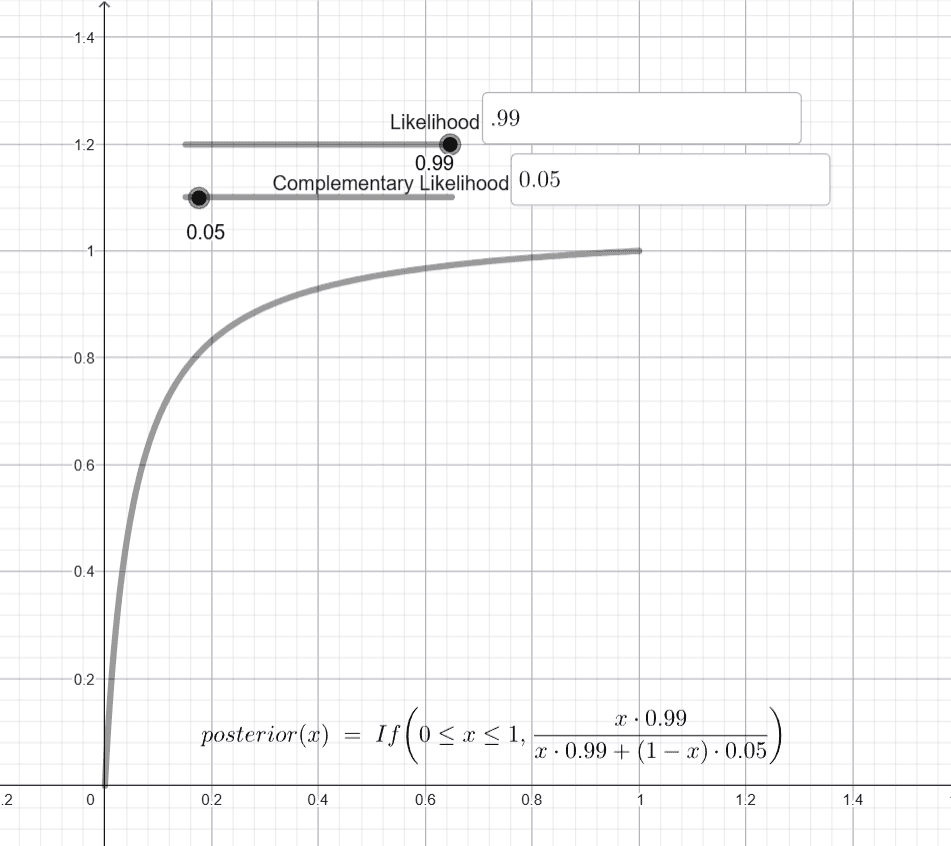
By: Krischal Khanal We've established the Bayes' Theorem as following formula that allowed inverting the conditional probabilities: $$P(A|B) = \frac{P(A)}{P(B)} \cdot P(B|A)$$ Now let's see how we could use the same theorem for the second, and arguably more profound application: updating belief. Have you got the disease? Suppose there's a rare disease. Only 1 in 1000 people have it. You suspect you may have it, and take a diagnostic test. The test comes back positive. How worried should you be? If you thought it depends on the accuracy of the test, you are on the right path. The test's accuracy is as follows: If you have the disease, the test catches 99% of the time (sensitivity, recall). If you don't have the disease, the test incorrectly flags you 5% of the time (false positive rate). Normally, if test is positive, people tend to think this is a worrying result. It has a high accuracy after all. This is known as falling for "Bayesian Trap". In reality, if the disease is so rare, most of the positive cases are false positives than the true ones. Let's unravel how we could go about reasoning clearly ourselves. The disease affects only 1 in 1000 people people. In absence of any clues, it's fair to assume I am equally susceptible to the disease. Thus I choose to believe the chance of me having the disease is 1 in 1000. Now that the test result is positive, it's either: A: I do have the disease, and test result is positive. It's 99% chance inside 0.1% of having disease = .099% B: I don't have the disease, but still the test result is positive. It's 5% chance inside 99.9% of me not having the disease = 4.995% Conclusion 1: Since, I am still more likely to get a positive result in case B, it's probably the case that I do not have the disease. Conclusion 2: However, the odds now have changed to A:(A+B) = 1.9% Thus, my suspicion of me having disease have risen to nearly 2%(which was only 0.1% originally). My suspicion rose from 1 in 1000 to 1 in 50. Bayes Theorem allows us to do just that using a single formula. Let's understand some terminologies first: Priori and Posteriori The hypothesis before seeing an evidence is a priori. Examples are: I choose to believe the chance of me having the disease is 1 in 1000, just as the normal population. P(H) = 0.001 = 0.1% I have a few other symptoms as well, thus I think it's 1 in 9 chance that I have this disease. P(H) = 0.111 I am male, thus chance of me being pregnant is zero. P(H) = 0 The your original belief (the priori) gets updated after you observed the evidence and becomes your new belief (a posteriori). Examples: Given the positive test result, my suspicion has risen to 2%. P(H | E=positive) = 2% Given the negative test result, I think my suspicion has come down. My P(H|E=negative) = 0.0013 Even when pregnancy test says positive, my chance of being pregnant is still zero. P(H|E) = 0 Actually applying the Formula $$\underbrace{P(H|E)}{\text{posterior}} = \frac{\underbrace{P(H)}{\text{prior}} \cdot \underbrace{P(E|H)}{\text{likelihood}}}{\underbrace{P(E)}{\text{marginal}}}$$ In the disease example: $H$ : You have the disease (Hypothesis) $E$ : You tested positive (Evidence) $P(H) = 0.001$ (Prior) $P(E|H) = 0.99$ (likelihood) $P(\neg H) = 1 - P(H)= 0.999$ (Prior's complement) $P(E|\neg H) = 0.05$ (Complementary likelihood) The marginal $P(E)$ is the total probability of testing positive. This value depends on your priors and the likelihoods. $$P(E) = P(H) \cdot P(E|H) + P(\neg H) \cdot P(E|\neg H)$$ Here, $$P(E) = (0.001)(0.99) + (0.999)(0.05) = 0.00099 + 0.04995 = 0.05094$$ Now applying Bayes' Theorem $$P(H|E) = \frac{0.001 \times 0.99}{0.05094} \approx 0.01943$$ So, after taking the test, if it turns out positive, your suspicion raises to 2%. That forms your new belief, an updated hypothesis in the light of an evidence. Bayesian reasoning process "In general, 1 in 1000 people have this disease, so before any test, let's start with that as a starting belief. Now, if I did have it, this test would be positive 99% of the time. And if I didn't, it would still be positive 5% of the time. The disease is so rare that even a 5% false alarm rate across 999 healthy people produces far more false positives than the test produces true positives from the 1 sick person. So yes, I tested positive but most people who test positive are healthy. I'm probably fine, but I am more suspicious that I may actually have it." What data do we need for Bayesian reasoning? One and only important information we need is the family of likelihoods. Likelihood $P(E|H)$: How probable the evidence is, when the hypothesis is true. This is same as the True Positive Rate, Recall, or sensitivity. Complementary likelihood $P(E | \neg H)$: How probable the evidence is when the hypothesis is false. This is same as the False Positive Rate or Type-1 Error rate. We also depend on the following assumption. Prior $P(H)$: Although this is only your belief (an assumption or an educated guess), and not an empirical data, this also affects your Bayesian reasoning. How prior affects the bayesian reasoning. ![[Bayes Theorem Blog Series/Bayes' Graph 1.png]] You can view this graph interactively As you can see, this graph always start at (0,0) and ends at (1,1). This means if you prior is 0 (complete denial), the Bayes' Theorem cannot update your belief. And so is the case if your prior is 1 (absolute certainty). This leads to a conclusion that: You cannot update a certainty. Even mathematically, if $P(H) = 0$: $$P(H|E) = \frac{0 \cdot P(E|H)}{{0 \cdot P(E|H)+ 1 \cdot P(E | \neg H)}} = \frac{0}{P(E | \neg H)} = 0$$ And if $P(H) = 1$: $$P(H|E) = \frac{1 \cdot P(E|H)}{1 \cdot P(E|H)+ 0 \cdot P(E | \neg H)} = \frac{P(E|H)}{P(E|H)} = 1$$ [!question]- What if both $P(H)$ and $P(E|\neg H)$ equal to 0? This is a special case. In this case, a. you believe hypothesis cannot be true, and b. evidence cannot appear when hypothesis is false. So, if you are right, the evidence never appears, making this case impossible. However, if evidence did appear, you must reconsider the complete denial. [!question]- what if $P(H) = 1$ and $P(E|H)=0$? This is the similar to above. In this case, a. you believe hypothesis is absolutely true, and b. evidence cannot appear when hypothesis is true. So, if you are right, evidence never appears, making this case again impossible. Likewise, if evidence did appear, you must reconsider your belief of absolute certainty. Do you feel sometimes, when trying to convince someone who is completely certain of something, no matter what evidence or fact you show up, you can never convince them otherwise? Bayes' theorem provides some insight about why that's the case. Of course, real life situation is never that simple. But this provides strong mathematical reason to avoid holding the belief of certainty. Never blindly accept or completely reject the hypothesis. Always keep an open mind. In statistics, this is known as the Cromwell's Rule. This rules warns against assigning the prior with the probability of 0 or 1. In the next blog, we'll look into coding the Bayes' Theorem for updating belief. Code blocks are licensed under the MIT License. All other content is licensed under CC-BY 4.0 Copyright © 2026 Krischal Khanal.
Decoration
What is Bayes' Theorem : Part 1
June 8, 2026
What is Bayes' Theorem : Part 1
By: Krischal Khanal Textbook definition The following is the mathematical definition for the Bayes' Theorem in standard textbook: [!note]+ Bayes' theorem $$P(H | E) = \frac{P(H) \cdot P(E | H)}{P(E)}$$ Sometimes it's also written as: $$P(H | E) = \frac{P(H) \cdot P(E | H)}{P(H) \cdot P(E | H) + P(\neg H)P(E | \neg H)}$$ Where the meaning of the symbols are as follows: $H$ : A symbol for a hypothesis $E$ : A symbol for an evidence/event $\neg$ : Negation symbol ($\neg H$ means the negation of Hypothesis $H$) $P(H | E)$: Probability of H conditioned on E And the standard terminologies: $P(H | E)$: Posterior Probability $P(E|H)$: Likelihood $P(H)$: Prior Probability $P(E)$: Marginal Probability While trivial to some, there might still be something new in this blog. It might be worth sticking around. There are two main application of the Bayes' Theorem: Inverting the conditional probability Updating the belief. In this blog, we are going to deal with the first. We will deal with the second one in the upcoming blog series. Simple proof First, let's greatly simplify Bayes' Theorem: Its just same as the following: $$P(H|E) = \frac{P(E,H)}{P(E)}$$ Isn't this the same formula for calculating [[#Conditional probability|conditional probability]] from [[#Marginal and joint probabilities]]? Yes. Indeed it is. $$P(E, H) = P(H| E) \cdot P(E) \tag{1}$$ and it's also the case that, $$P(E, H) = P(E | H) \cdot P(H) \tag{2}$$ Using (1) and (2) $$P(H|E) \cdot P(E) = P(E|H) \cdot P(H) \tag{3}$$ With a simple rearrangement: $$P(H | E) = \frac{P(E|H) \cdot P(H)}{P(E)} \tag{4}$$ Which is the same as the Bayes' Theorem. Marginal and joint probabilities If you already know this part you can skip this. Example You have a deck of cards. Your interested property of the card are (i) if the card is red and (ii) if the card's rank is 4. A randomly chosen card Color (Joint probability) Rank (Marginal probability) Red Not Red Rank (Joint Probability) 4 P(4 and Red) P(4 but not Red) P(4) Not 4 P(Red but not 4) P(Neither Red nor 4) P(Not 4) Color (Marginal probability) P(Red) P(Not Red) 100% The joint probabilities consider all the cases, and the marginal probabilities are calculated by summing the joint probabilities of all such cases. Thus, P(card is 4) = P(card is 4, card is red) + P(card is 4, card is not red) Mathematically, $$P(A) = P(A, B) + P(A, \neg B) \tag{5}$$ Conditional probability Continuing on the [[#Example|above example]], the conditional probability is the probability when you already know some of the case are true. For example, P(card is 4 | card is red) = if you already know the card is red, what is the probability that the card is 4? You can use conditional probability and marginal probability to calculate joint probability. What is the probability that the card is red and card is 4? It has to be red first, then it has to be also 4 when it is red. P(card is red, card is 4) = P(card is red ) $\times$ P(card is 4| card is red) Mathematically, $$P(A, B) = P(A) \cdot P(B | A) \tag{6}$$ Rearranging this, we get the following formula $$P(B|A) = \frac{P(A, B)}{P(A)} \tag{7}$$ Which is the simplified version of Bayes' Theorem in the [[#Simple proof]] There is also missing half of the Bayes' Theorem, not normally covered in the textbook and most resources online. For that, stay tuned in for the upcoming blog in the series. Code blocks are licensed under the MIT License. All other content is licensed under CC-BY 4.0 Copyright © 2026 Krischal Khanal.
Decoration
Out-of-Distribution Detection
April 20, 2026
Out-of-Distribution Detection
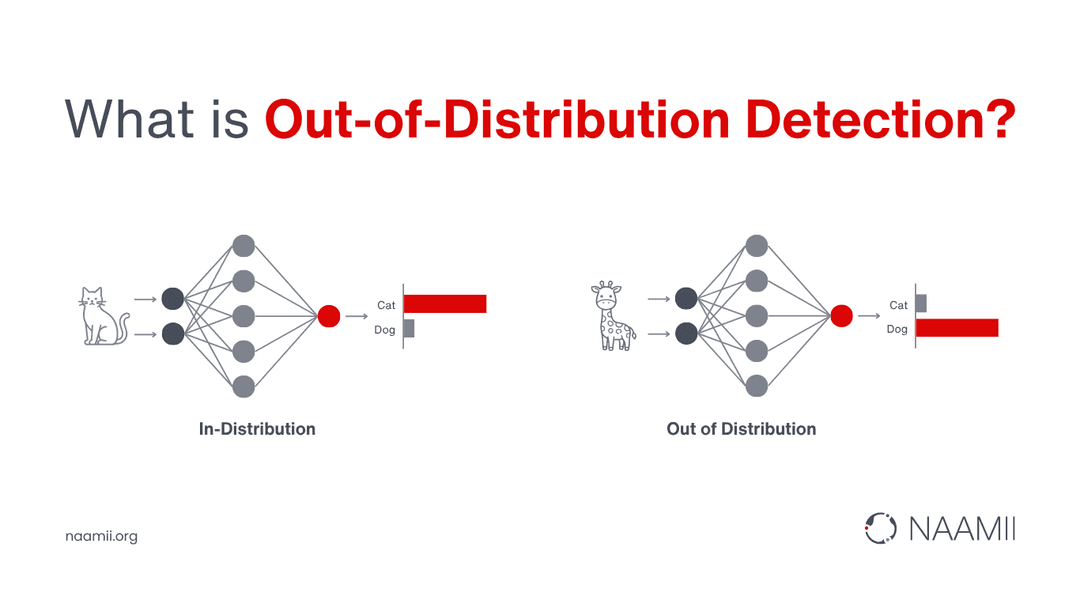
Author: Anju ChhetriIn a now-famous study, expert radiologists were asked to scan CT images of lungs for nodules. Hidden in one of those scans was something no one expected: a gorilla, 48 times the size of the average nodule. However, interestingly more than half the radiologists never noticed it. Their attention was so finely tuned to detecting tumors that they overlooked an unexpected and obvious anomaly. This phenomenon is known as inattentional blindness, where focused expertise can paradoxically limit perception [1].While this finding is surprising, its implications extend far beyond human cognition. It offers a powerful analogy for understanding a critical challenge in machine learning. Consider a model trained to detect malignant cancer cells. It performs well when the input data resembles what it has seen during training. But what happens when it encounters a completely new disease, something outside its learned distribution? This scenario is known as out-of-distribution data, where the statistical properties differ from the training set.In such cases, the model does not recognize its own uncertainty. Instead, it forcefully maps the unfamiliar input to one of its known categories. The result can be a confident but incorrect prediction, potentially leading to dangerous misdiagnoses. This limitation arises because most machine learning systems operate under what is called a closed-world assumption. They assume that every input belongs to one of the predefined classes.[2]This challenge is not limited to healthcare. In domains like self-driving cars, encountering unexpected objects or rare environmental conditions can lead to similarly flawed decisions. A plastic bag drifting across the road or an unusual vehicle shape may not fit neatly into the model’s learned categories, yet the system must still respond.To address this, researchers focus on out-of-distribution detection. The goal is to identify when an input does not belong to the training distribution and flag it instead of forcing a classification. But this raises a key question. If a model is trained only to assign inputs to known classes, how can it recognize something unfamiliar?One approach is to look beyond final predictions. Instead of relying solely on class labels, we can analyze intermediate signals within the model. These include internal representations, logits, and probability scores. Patterns in these signals can help distinguish familiar inputs from anomalous ones, sometimes using a combination of multiple indicators [3,4,5].But OOD detection alone isn't enough. As models grow more complex, a deeper question emerges: how do we understand and trust the decisions they make? This demands collaboration beyond machine learning robustness, drawing in interpretability research and explainable AI to make model behavior transparent, not just accurate.[1] Drew, Trafton, Melissa L-H. Võ, and Jeremy M. Wolfe. "The invisible gorilla strikes again: sustained inattentional blindness in expert observers." Psychological science 24.9 (2013): 1848-1853.[2] Hou, Mun. “Detecting Out-of-Distribution Samples with kNN | Mun Hou’s Blog.” Detecting Out-of-Distribution Samples with kNN , 2022, blog.munhou.com/2022/12/01/Detecting Out-of-Distribution Samples with Knn/.[3] Wang, Haoqi, et al. "Vim: Out-of-distribution with virtual-logit matching." Proceedings of the IEEE/CVF conference on computer vision and pattern recognition. 2022.[4] Hendrycks, Dan, and Kevin Gimpel. "A baseline for detecting misclassified and out-of-distribution examples in neural networks." arXiv preprint arXiv:1610.02136 (2016).[5] Lee, Kimin, et al. "A simple unified framework for detecting out-of-distribution samples and adversarial attacks." Advances in neural information processing systems 31 (2018). 
Decoration
3-Day AI-driven System for Post-Disaster Agricultural Damage Assessment Workshop Concludes
November 30, 2025
3-Day AI-driven System for Post-Disaster Agricultural Damage Assessment Workshop Concludes
Date: 19–21 November 2025Venue: Alice Reception, Lalitpur (Day 1) & Alliance Française, Lalitpur (Day 2 and 3)NAAMII, with support from FAO Nepal, concluded a three-day workshop designed to bring key stakeholders together around a unified approach for post-disaster agricultural damage assessment. The sessions were part of the ongoing A2 Innovation Lab project with FAO Nepal, which aims to strengthen Nepal’s capacity to use drones, geospatial systems, and AI for timely and transparent crop loss estimation.The workshop centered on aligning perspectives from farmers, local governments, technical agencies, and national institutions to validate and refine standard operating procedures. Alongside these discussions, it also educated students and young practitioners in UAV operations, GIS workflows, and AI-based image analysis.Day 1The first day focused on establishing a shared technical foundation. Bal Kumar Lamsal, Drone and GIS Data Officer at NAXA, provided an overview of UAV types, autonomous systems, and mapping software including PICTERRRA and PIX4D React. Er. Moti Ram Itani, Aeronautical Engineer and Founder of Pushpak Udaan Aviation Academy, shared his expertise on aircraft design, drone policies, and licensing regulations in Nepal. Practical demonstrations by Sishir Lamsal helped participants understand flight planning, geospatial data collection, and software applications, providing a foundational knowledge of drones, mapping, and AI integration, setting the stage for practical problem-solving.Day 2The second day brought stakeholders into problem-driven discussions. Suyog Chalise from Impact 477 guided students through design thinking and problem identification. A representative from Amit drone consultancy demonstrated LiDAR applications for analyzing Nepal’s land and resources. Tashi Bista and Sajal Pradhan from Salt, a wildlife media company, shared their experiences in wildlife photography and videography, including collaborations with the BBC, and highlighted challenges in acquiring filming rights. The day concluded with Sishir Lamsal and Lalit BC demonstrating AI/ML model training for image analysis, enabling students to understand the intersection of drones and AI.Day 3The final day centered on feedback, real-world constraints, and pathways to scale. Arun GC from FAO Nepal delivered opening remarks and feedback, followed by Ritesh Jha from the Department of Hydrology who discussed challenges in precision agriculture and flood damage assessment, emphasizing how drone-based AI/ML solutions can improve accuracy and decision-making. Participants explored scaling prototypes, integrating with existing systems, and using baseline data for predictive analysis, gaining practical insights into turning technology into tangible impact. The sessions concluded with discussions on how these projects could be further developed to benefit farmers, local governments, and disaster management efforts across Nepal.The workshop strengthened coordination among institutions, technical experts, and young practitioners, creating momentum for a national system that links drone data, geospatial analysis, and AI into a unified and reliable process for agricultural damage assessment across Nepal.
Decoration
Research